
SEO credibility is how trustworthy your site looks to the people searching and to the systems deciding what they see. It comes down to things you can actually check. Is it obvious who's behind the content? Are the claims backed by evidence? Is the information current? Can search engines see the page properly? Credible pages earn clicks, links and enquiries, which is why credibility shows up in rankings and in sales at the same time.
Google puts trust at the center of all this. Its guidance on creating helpful, reliable content says it plainly: "Of these aspects, trust is most important."
What Google Says About E-E-A-T and Trust
E-E-A-T stands for experience, expertise, authoritativeness and trustworthiness. Two points from Google's guidance clear up most of the confusion around it. First, it isn't a single ranking factor; Google uses a mix of signals that tend to identify content with good E-E-A-T. Second, content doesn't need all four at once. A customer's review of a product leans on experience, while a tax guide needs expertise.
The same guidance explains where the idea comes from. Search quality raters are trained to judge whether content shows strong E-E-A-T, and their feedback helps Google check its systems, but raters have no control over how any individual page ranks. So treat E-E-A-T as a description of what Google's systems try to reward. It isn't a checklist a plugin can tick for you.
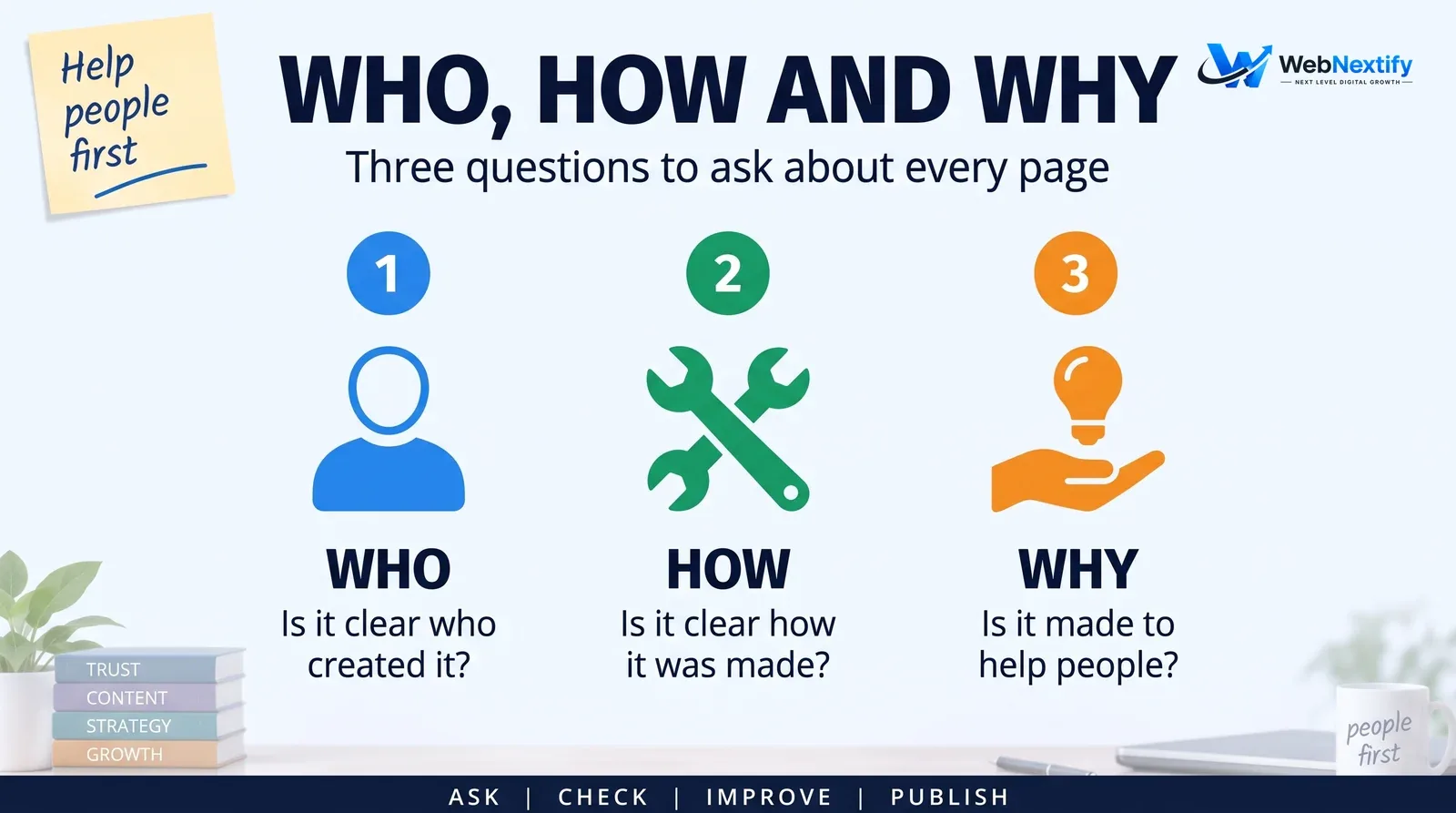
Google also suggests asking "Who, How and Why" about every page. Is it obvious who created it? Is it clear how it was produced? Was it made mainly to help people, or mainly to attract search traffic?
Credibility Signals You Can Improve
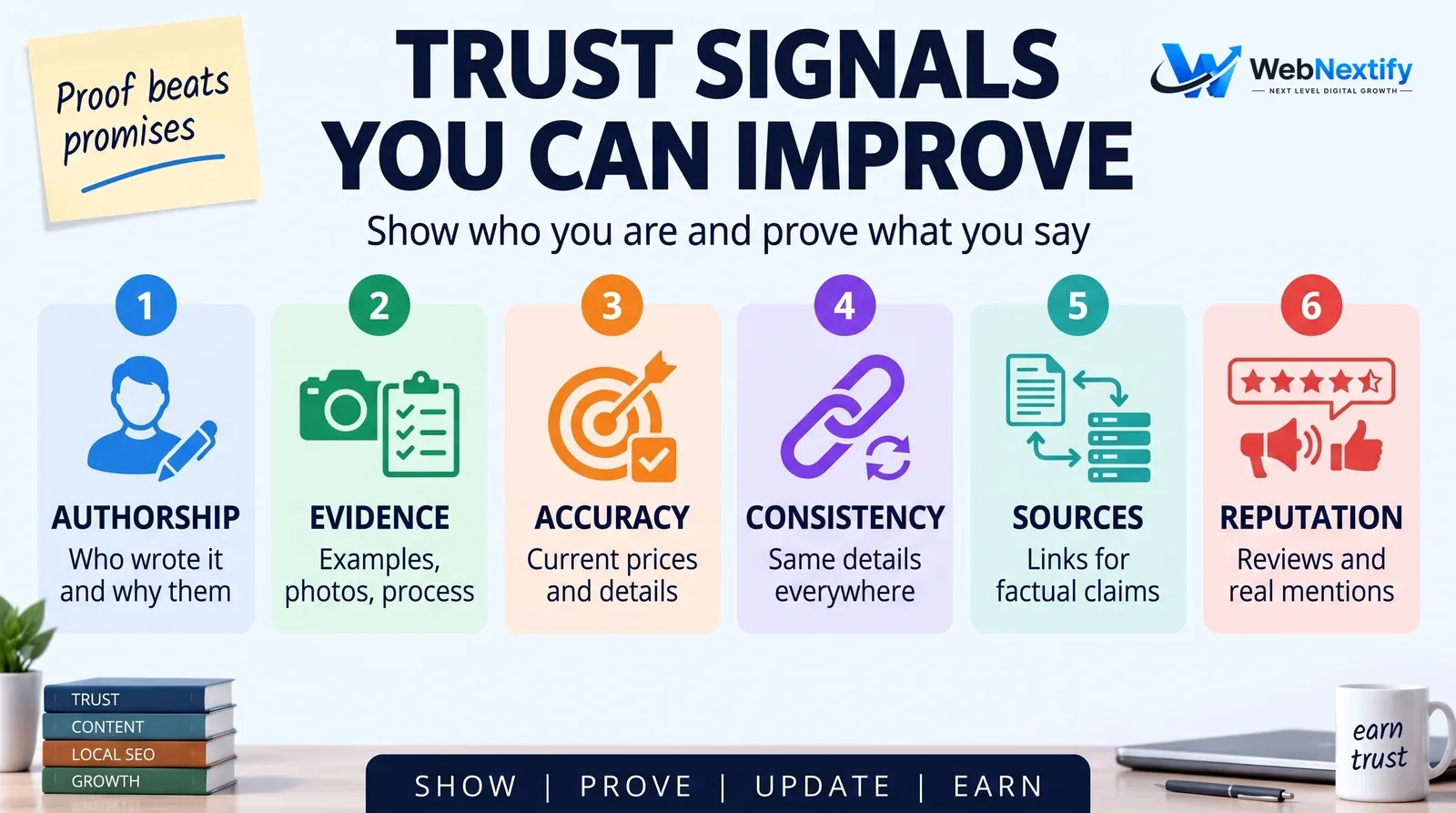
Clear authorship and ownership
Show who wrote or reviewed the content and why they're qualified to, with a short bio linking to a fuller author page. Make it easy to find who runs the business: a real about page, photos of the actual team, a physical address where it applies, and a way to reach a person.
Evidence, not claims
Swap "we're the best in town" for proof. Show specific examples of your work, before-and-after photos and your process step by step. Give pricing ranges. List the certifications you genuinely hold. Show reviews from real customers. This is the "SEO proof" that persuades a hesitant buyer, and it gives search engines something concrete to work with.
Accuracy and freshness
Out-of-date prices damage trust fast. So does a closed location still listed as open, or a team page showing someone who left two years ago. Review key pages on a schedule, show when important content was last updated, and correct mistakes openly rather than quietly.
Consistent business information
Your name, address and phone number should match everywhere. Check the website against your Google Business Profile first, then the big directories. When the details disagree, customers and search engines are both left guessing which one is right.
Sources for factual claims
Link to official or original sources when you state a fact, a statistic or a rule. It lets readers check you, and it shows you did the homework.
Secure, professional basics
HTTPS on every page. No pop-up blocking the content the moment someone arrives. A contact form that actually sends, and privacy and returns policies people can find. None of these will rank a page on its own, but missing ones send visitors straight back to the results.
Reputation off your site
What others say about you counts, and it increasingly shapes AI answers too, because assistants tend to repeat what reputable third-party sites say about a business. That means reviews on the platforms your customers use, mentions in local press or trade publications, and links from relevant organizations. You can't fake these for long. You earn them by doing good work and asking happy customers to say so.
See What Google Sees
Credibility only helps if search engines can see it. Reviews loaded by a script, author details baked into an image, or content that only appears after a click may be invisible to them.
Use URL Inspection in Search Console. A live test lets you view a screenshot of the rendered page as Google's inspection tool sees it, along with the raw HTML and any JavaScript errors. Run it on your most important pages and confirm the main content and author details are there. Then look for the reviews, which is where things most often go missing.
SEO Tests Worth Running
Credibility work is easier to justify when you can show it worked. Small and mid-sized sites can run a few simple tests.
Rewrite the titles on a group of similar pages to be more specific, then compare click-through rate in Search Console over the next few weeks against a similar group you left alone. Add real evidence, such as examples, photos and process details, to a handful of service pages and compare their conversions with untouched ones. Add author bios to a set of articles and watch engagement and search performance. Or link to struggling pages from your strongest ones and see whether impressions move.
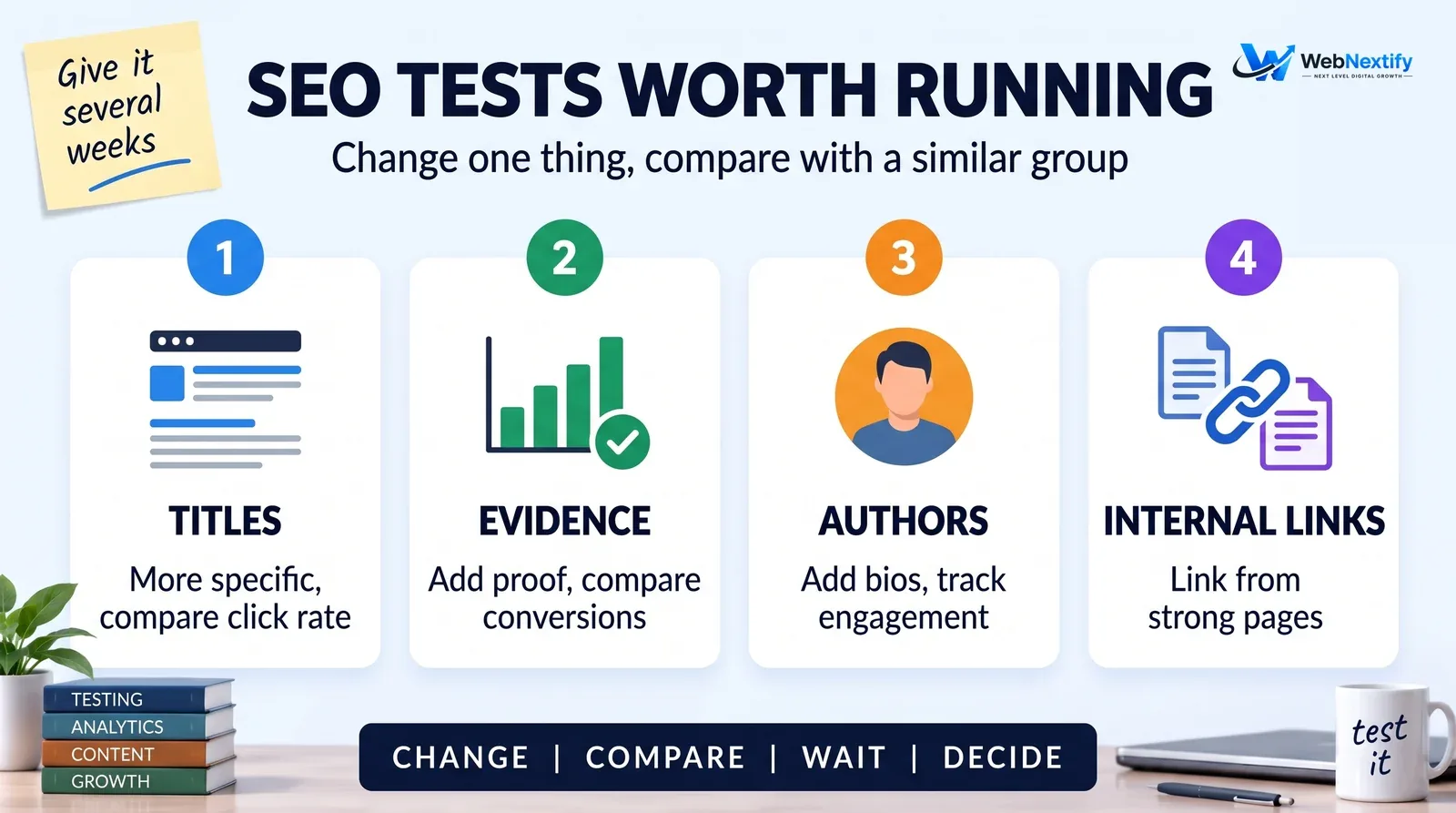
Change one thing at a time, always compare against a similar untouched group, and give each test several weeks. Search data is noisy, and a seasonal swing can look exactly like a result.
What "SEO Intelligence" Should Mean
The phrase gets stuck on a lot of tools. For a business, useful SEO intelligence answers plain questions: which searches bring customers, where competitors appear and you don't, which pages are losing visibility, and why. Search Console and GA4 answer most of that, with a crawler for the technical side. Paid tools add competitor estimates. Data only becomes intelligence when somebody turns it into a decision.
Get Help Building Credibility
If you'd like help working out what makes your site look less trustworthy than the competition, and fixing it, see our SEO services. For local businesses, an accurate Business Profile and strong reviews are a big part of credibility, which our local SEO services cover. For a quick technical check, try the free WebNextify SEO Report Generator.
Frequently Asked Questions
What is SEO credibility?
Is E-E-A-T a ranking factor?
How do I see what Google sees on my page?
What SEO tests should I run?
How do I prove SEO is working?
Do reviews help SEO credibility?
Summary
SEO credibility is trust you can show: who's behind the content, real proof of the work, accurate details everywhere, and a reputation other people confirm. Make sure Google can see all of it, then test changes one group of pages at a time.