
An international SEO audit answers one question for every market you sell into: does a searcher in that country, in that language, land on the right version of your site? It looks at how markets are split in your URLs, whether hreflang connects equivalent pages correctly, whether redirects or pop-ups block crawlers, whether the content is genuinely localized, and how each market performs in Search Console.
The audit usually starts with an annoyed email. A customer in Sydney lands on the US site, sees prices in dollars that aren't their dollars, calls a number that doesn't connect, and gives up.
Before You Start: Agree the Markets
Write down which countries and languages actually matter to the business, and rank them. An audit that spends as long on a market bringing in 2% of revenue as on the main one is wasting days. For each priority market, note which version should rank there, which currency it uses and which contact details it shows. That list becomes the test for every check that follows.
1. URL Structure by Market
Google describes four main ways to separate countries or languages, each with trade-offs.
| Structure | Example | Notes |
|---|---|---|
| Country-code domain | example.de | Clear signal for one country, but costly to run many |
| Subdomain | de.example.com | Easy to set up, less obvious to users |
| Subdirectory | example.com/de/ | Easy to maintain, shares one domain's strength |
| URL parameter | example.com?loc=de | Not recommended by Google |
Google's guidance on managing multi-regional sites covers the details. What the audit checks is consistency: one structure used across the whole site, not some markets on subdomains and others in folders because two different agencies set them up five years apart.
2. Hreflang
Hreflang tells Google which pages are equivalents in other languages or regions, so it can show searchers the right one. It's also where most international sites go wrong.
Every version has to list itself and all the others. Google states that each version must list itself as well as all other versions, and if two pages don't point at each other, the tags are ignored. Language and region codes must be valid; en-GB works, en-UK doesn't, and it's one of the most common slips. The URLs in hreflang should be canonical, indexable and return 200, not redirects or 404s. An x-default version helps visitors who don't match any listed market. And pick one method, whether HTML link tags, HTTP headers or the sitemap, and stick to it.
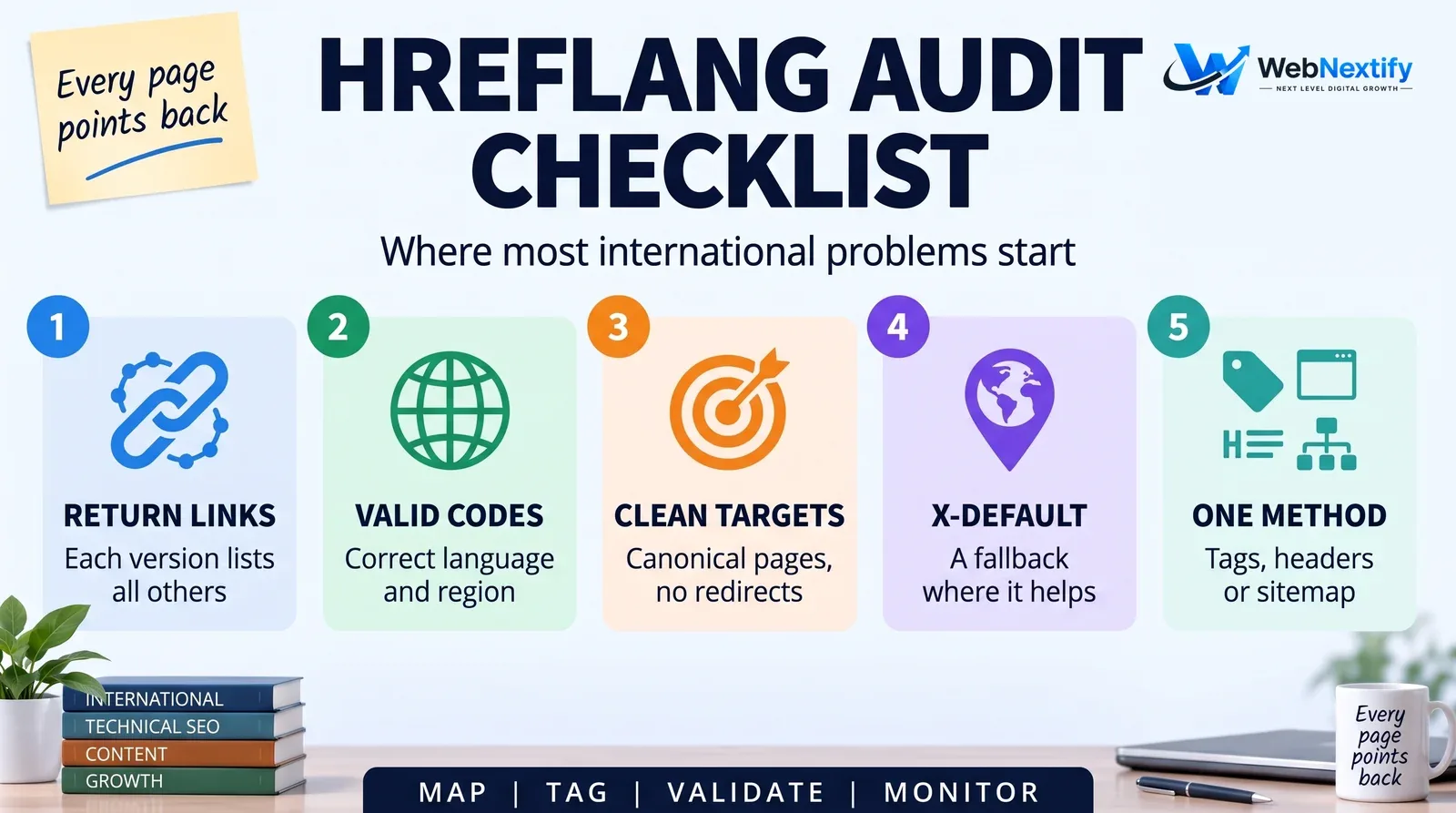
On a large site, checking this by hand is hopeless, so use a crawler that validates hreflang return links. Older guides still mention Search Console's International Targeting report, but Google retired it in 2022. A crawler or a dedicated hreflang checker is now the practical way to find these errors.
3. Redirects and Language Pop-Ups
Automatically redirecting visitors by IP address causes real trouble, because crawlers come from a limited set of locations and may never see your other versions at all. Google advises against using IP analysis to adapt your content.
Check that every version can be crawled without being bounced elsewhere. Country or language suggestions should appear as a banner the visitor can dismiss, never a forced redirect, and there should be plain links for switching versions.
4. Localized Content
Translated isn't the same as localized. For each market, check currency, prices, units, date formats and contact details first; those are the ones customers notice instantly. Then the language people actually search with: "holiday" or "vacation", "mobile" or "cell". Local reviews, case studies, addresses and legal pages belong here too, and so does keyword research done per market rather than translated from the main one.
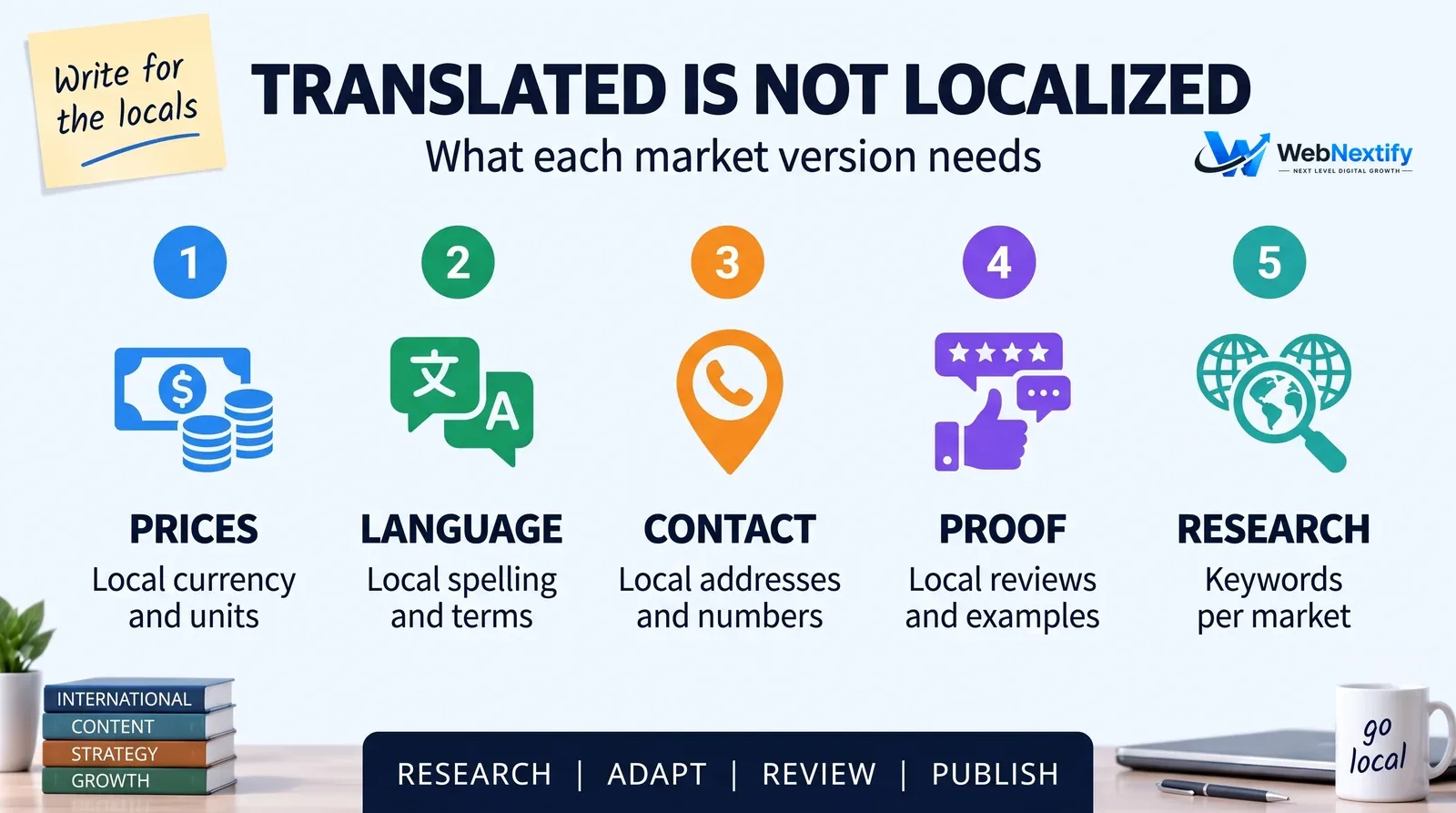
Near-identical pages for similar markets, like the US, UK and Australia, can get treated as duplicates if nothing meaningful differs between them. Hreflang helps. Real local differences help more.
5. Performance by Market
Filter the Search Console Performance report by country, and for each market look at clicks, impressions, top queries and which pages Google shows. Watch for the wrong country's version ranking in a market, one market losing visibility right after a release, and pages indexed under an unexpected canonical.
Check Core Web Vitals and server response times by region as well, especially if the site is hosted on another continent from some of its customers.
6. Tools for Each Market
Rank trackers and SEO tools have to support the countries you target. If you're shopping for SEO tools for Australia or any other specific market, confirm the tool tracks rankings from inside that country, ideally from specific cities, and has keyword data in the local language.
Common International SEO Mistakes
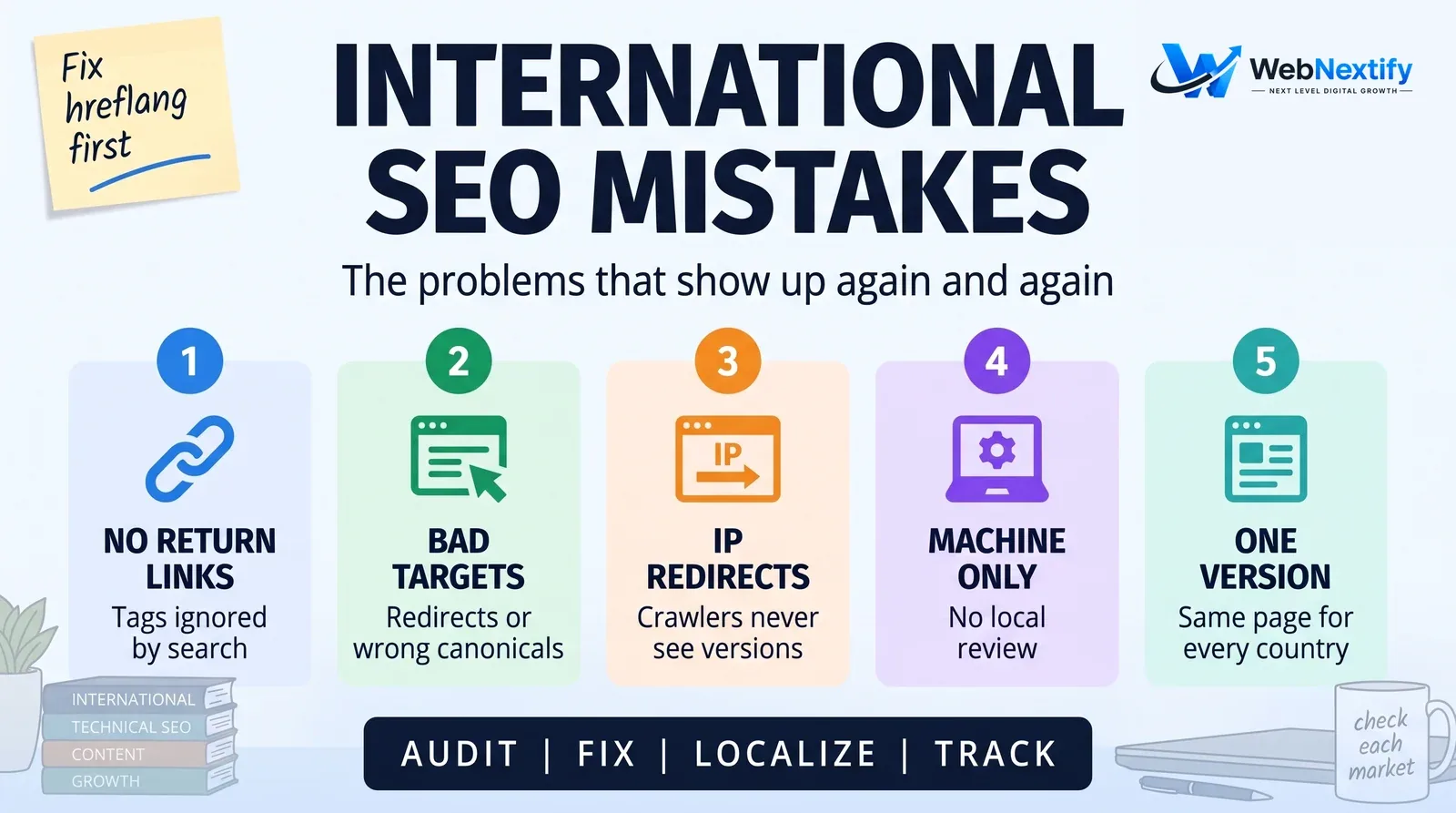
The same few problems turn up on almost every international audit. Hreflang without return links, or pointing at redirected and non-canonical URLs. Forced IP redirects. Machine-translated pages nobody local ever read. One English version trying to rank in four countries with four sets of spelling and prices.
The worst one is the quietest: canonical tags on every regional page pointing back to the main site. It tells Google the other versions are copies, and they drop out of search without anyone noticing for months.
Get an International Audit
If your site serves several countries or languages and the wrong versions keep showing up, our SEO services can audit hreflang, structure and content market by market. For the broader audit scope, see our SEO audit services guide.
Frequently Asked Questions
What is an international SEO audit?
What is the most common international SEO problem?
Should I use subdirectories or country domains?
Is it OK to redirect visitors by IP address?
Do I need separate content for the US, UK and Australia?
How do I check performance by country?
Summary
Audit an international site one market at a time. Look for one clear URL structure, hreflang with valid return links, no forced IP redirects and content that's genuinely local, then check Search Console country by country. Start with hreflang, because that's where most of the trouble begins.