
A professional SEO audit service should give you more than a list of technical errors. A useful audit identifies the search problems that matter for your website, shows the evidence behind each finding, explains the likely impact, prioritizes the work, and gives your team a clear path to implementation. Before hiring an SEO audit consultant or company, you should understand exactly what will be reviewed and what the final deliverable will contain.
The right provider depends on your website, internal resources, and the problem you are trying to solve. A small lead-generation site may need focused technical and content analysis, while an ecommerce, SaaS, international, or JavaScript-heavy website may require a deeper investigation. The goal is not to buy the longest checklist. It is to choose an audit that helps your team decide what to fix, why it matters, who should own the work, and how to verify the result.
What Is a Professional SEO Audit Service?
A professional SEO audit service is a structured evaluation of issues that may affect a website's organic search performance. Depending on the site, the audit can cover crawlability, indexation, technical configuration, site architecture, internal linking, on-page SEO, content, analytics, Search Console data, competitor visibility, and implementation priorities.
The important part is evaluation. An audit should not simply detect issues. It should determine which findings deserve attention and which ones are unlikely to justify immediate work.
SEO Audit vs Automated Site Scan
Automated tools are useful. They can crawl a website quickly, flag missing titles, identify broken links, detect status-code problems, find duplicate elements, and surface many other technical signals.
But a tool does not automatically know which issue matters most to your business. A crawler may report hundreds of missing meta descriptions while a smaller group of commercially important pages has an indexing or internal-linking problem that deserves attention first.
The tool finds signals. A professional audit adds context, validation, prioritization, and an implementation path.
SEO Audit vs Ongoing SEO Service
An audit is primarily diagnostic. It identifies problems, opportunities, dependencies, and priorities. An ongoing SEO service may include implementation, monitoring, content improvements, internal linking, technical fixes, reporting, and continued strategy after the initial diagnosis.
Before hiring, ask whether the engagement includes diagnosis only or whether the provider can also help implement and validate recommendations.
When Does Hiring an SEO Audit Specialist Make Sense?
Hiring an SEO audit consultant or agency can be useful when:
- Organic traffic or visibility has declined and the cause is unclear.
- A redesign, migration, or platform change is planned.
- A large website has crawl, indexation, duplication, or architecture concerns.
- Internal teams have conflicting SEO priorities.
- A business wants an independent review before increasing SEO investment.
- Search performance has stalled despite ongoing content or technical work.
- An automated audit has produced more issues than the team knows how to prioritize.
The audit should answer a specific business or search problem rather than exist simply because an SEO tool can generate one.
What Should an SEO Audit Service Actually Include?
There is no universal checklist that every professional SEO audit must follow. Scope should depend on the website and the reason for the audit. Several workstreams, however, commonly deserve consideration.
Technical SEO
Technical review can include areas such as:
- Crawl accessibility
- Indexation
- HTTP status codes
- Canonicalization
- XML sitemaps
- Robots directives
- JavaScript rendering where relevant
- Duplicate or near-duplicate URLs
- Mobile accessibility
- Page templates and site architecture
[Google's technical requirements](https://developers.google.com/search/docs/essentials/technical) explain that Googlebot must not be blocked, the page must return an HTTP 200 success status, and the page must contain indexable content to be eligible for indexing. These requirements are useful diagnostic foundations, but an audit should not turn individual checks into a universal ranking formula.
Site Architecture and Internal Linking
An audit may examine whether important pages are easy to reach, whether internal links support priority sections, and whether the site structure makes relationships between pages clear.
The key question is not simply how many internal links a page receives. It is whether important pages are discoverable, contextually connected, and supported by a logical architecture.
On-Page SEO
On-page review can include:
- Search intent alignment
- Titles and headings
- Main page content
- Duplicate targeting
- Internal links
- Page-level relevance
- SERP presentation
- Content that no longer serves a useful search purpose
A professional audit should not recommend rewriting every page merely because a tool score falls below an arbitrary threshold.
Content and Search Performance
A useful audit can connect page-level analysis with actual search-performance data.
Questions may include:
Which pages generate impressions but few clicks?
Which important pages lost visibility?
Are several pages competing for the same topic?
Are important commercial topics missing from the site?
Is traffic concentrated in content that does not support business goals?
This is where Search Console and analytics data can make the audit more useful than a crawler export alone. For setup and diagnostic context, use WebNextify's [Google Search Console guide](/blog/google-search-console-webmaster-tools).
Competitor and Opportunity Analysis
Competitor analysis can help identify content gaps, positioning differences, topic coverage, and search opportunities.
It should not become a simple comparison of who has more keywords or backlinks.
A competitor doing something is not evidence that you should copy it. The audit should determine whether an observed opportunity matches your customers, products, resources, and search intent.
What Should the Final SEO Audit Deliverable Look Like?
The final audit deliverable should help someone act on the findings without having to rediscover every problem.
A practical quality framework is:
Finding, Evidence, Impact, Priority, Recommended Fix, Owner, and Verification
For examples of how findings and recommendations can appear in finished reports, review WebNextify's [SEO report examples and samples](/blog/seo-report-examples-samples).
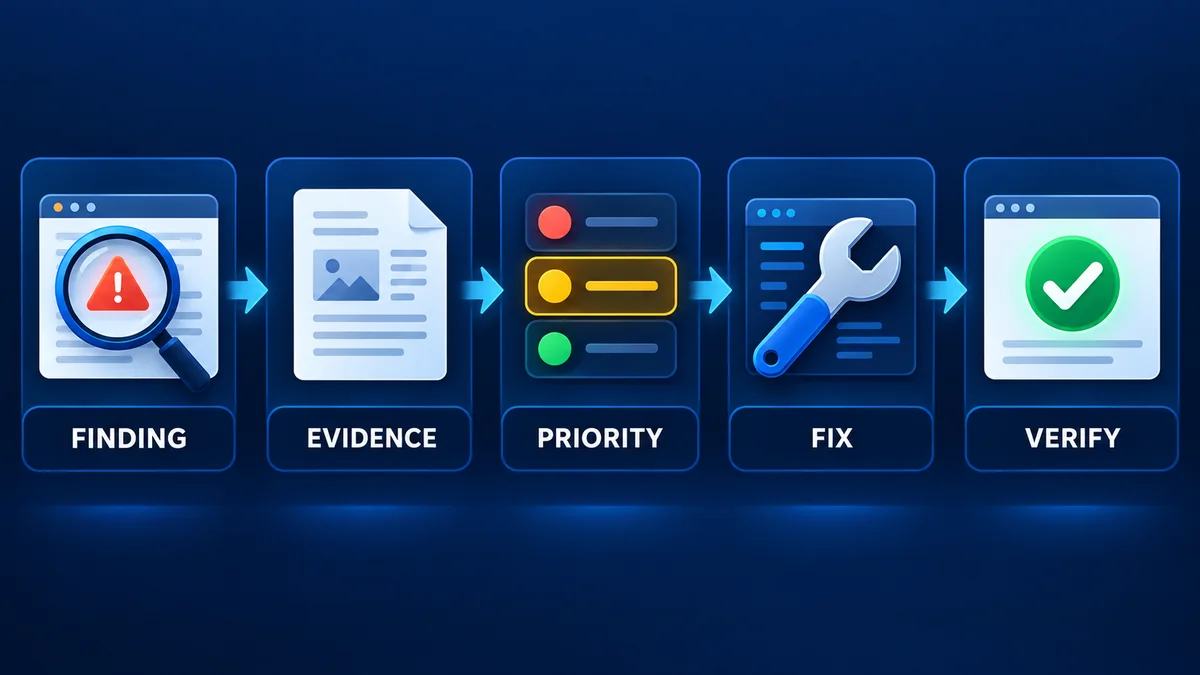
An actionable audit connects each finding to evidence, priority, implementation and verification.
Finding
State the problem clearly.
Avoid vague descriptions such as:
"SEO issues exist on category pages."
A more useful finding identifies the affected page group and the actual problem.
Evidence
Show what supports the finding.
Evidence can include affected URLs, crawl data, Search Console performance, rendered-page observations, source code, internal-link patterns, or other relevant diagnostics.
Impact
Explain why the issue deserves attention.
Avoid pretending that every technical issue causes a measurable ranking loss. A stronger audit explains the possible consequence and why it matters to the site.
Priority
Not every problem should be fixed first.
Prioritization can consider:
- Business importance
- Number of affected URLs
- Search visibility
- Technical dependencies
- Implementation effort
- Risk
- Confidence in the diagnosis
Recommended Fix
"Improve SEO" is not an implementation recommendation.
A strong audit should explain what needs to change and, where useful, identify the templates, page groups, or systems involved.
Owner
Some recommendations belong to developers. Others belong to content, analytics, product, design, or SEO teams.
Identifying likely ownership makes implementation easier.
Verification
The audit should explain how the team can check whether an important fix was implemented correctly.
This turns the report into an implementation tool rather than a document that disappears after the presentation.
SEO Audit Consultant vs Agency vs Automated Tool
The right option depends on website complexity, internal capability, and the support required.
| Option | Often suitable for | Main strength | Common limitation |
| --- | --- | --- | --- |
| SEO audit consultant | Focused diagnosis or specialist review | Direct specialist access | Capacity may be limited |
| SEO audit agency | Complex or cross-functional projects | Wider technical and implementation resources | Engagement may be broader |
| Automated audit tool | Routine checks and issue discovery | Fast, repeatable monitoring | Limited business context and prioritization |

Consultants, agencies and automated tools provide different levels of specialist access, resources and context.
SEO Audit Consultant
A consultant can be a strong choice when you need focused expertise and direct access to the person performing the analysis.
Before hiring, confirm whether that person will actually conduct the audit or whether most work will be delegated.
SEO Audit Company or Agency
An agency may be suitable when the audit requires several disciplines, such as technical SEO, content, analytics, development coordination, ecommerce architecture, or international SEO.
The value should come from relevant capability, not simply from having a larger team.
Automated Audit Tool
Tools can be excellent for discovery and recurring monitoring, especially for detecting changes at scale.
But a tool-generated issue list should not automatically be treated as a professional audit.
Tools provide signals. Someone still needs to determine context, priority, and action.
How Much Audit Scope Does Your Website Need?
Audit depth should match website complexity. A focused service site and a multilingual ecommerce platform should not automatically receive the same scope simply because both need an SEO audit.
Small Lead-Generation Website
A smaller service website may need focused review of:
- Crawl and indexation
- Important service pages
- Internal linking
- Commercial search visibility
- Conversion paths
- Search Console and analytics setup
The value comes from identifying the issues most likely to matter, not producing a massive report.
SaaS or Content-Heavy Website
A SaaS or publishing site may require deeper analysis of:
- Topic overlap
- Large content libraries
- Indexation patterns
- Product and solution pages
- Internal links
- Outdated content
- Search intent
- Tracking and attribution
Ecommerce Website
Ecommerce audits can become more complex because of:
- Category and product templates
- Faceted navigation
- Parameter URLs
- Product availability
- Internal linking at scale
- Duplicate-content patterns
- JavaScript
- Large inventories
Enterprise or International Website
Larger environments may require analysis across:
- Multiple subdomains
- Countries or languages
- Development teams
- Rendering systems
- Governance processes
- Large URL inventories
- Migration history
- Complex tracking systems
Migration or Redesign
Migration audits have a different purpose from routine health checks.
They may need to focus on URL mapping, redirects, canonicals, internal links, metadata, indexation, template changes, analytics, and post-launch validation.
This is why comparing providers only by the number of promised audit checks can be misleading.
What Happens During a Professional SEO Audit?
A professional engagement usually begins with context, not crawling.
1. Discovery
The provider should understand:
- Business goals
- Important products or services
- Known problems
- Recent migrations or redesigns
- Priority markets
- Internal resources
- Current SEO activity
2. Data Access
Depending on scope, the provider may request access to Search Console, analytics, crawling tools, CMS information, or other relevant systems.
The provider should explain why each access request is needed.
3. Diagnostics
This stage can include crawling, technical review, search-performance analysis, page review, competitor research, and other agreed workstreams.
4. Prioritization
Findings should be grouped and ordered based on importance, confidence, dependencies, and implementation effort.
5. Findings Review
A walkthrough is useful because written recommendations can be misunderstood.
The buyer should be able to ask why an issue received its priority and what evidence supports it.
6. Roadmap and Handoff
The final stage should translate findings into work that developers, marketers, content teams, or other owners can execute.
Weak SEO Audit vs Actionable SEO Audit
Consider this illustrative example. It demonstrates audit quality and is not a real client result or WebNextify case study.
Weak Audit Finding
"47 pages have duplicate titles. Fix duplicate title tags."
The statement may be technically correct, but it leaves several questions unanswered.
Which 47 pages?
Are they important?
Why are they duplicated?
Is one template responsible?
Should all of them remain indexable?
What should be fixed first?
Actionable Audit Finding
"Forty-seven URLs share a template-generated title. Eighteen are indexable commercial pages receiving search impressions. Prioritize the commercial template first, update the affected pages, then validate the remaining URLs separately because some may not require individual optimization."
The second version provides context, an affected group, priority, and a practical next step.
That is the difference between detecting an issue and delivering an audit someone can act on.
What Affects SEO Audit Pricing?
There is no responsible universal price for every SEO audit. Scope can vary substantially.
Important cost drivers can include:
- Number of URLs
- Site architecture
- Ecommerce complexity
- JavaScript rendering
- Number of countries or languages
- Analytics and tracking review
- Competitor analysis depth
- Content analysis depth
- Migration requirements
- Turnaround expectations
- Implementation guidance
- Follow-up validation
A higher price does not automatically mean a better audit. A lower price does not automatically mean a poor one.
Compare scope, methodology, deliverables, level of manual analysis, communication, and implementation support.
Red Flags in SEO Audit Services
A Tool Export Presented as the Complete Audit
A crawler report can be useful input. It should not automatically be the finished service.
Hundreds of Issues With No Priorities
More issues do not necessarily mean more value.
A professional audit should help the team decide what deserves attention first.
No Evidence or Affected URLs
Recommendations are difficult to validate when the provider cannot show where the problem exists.
No Connection to Important Pages
A technically correct finding may still have little business importance.
Strong audits distinguish critical search pages from low-value URLs.
Guaranteed Ranking Outcomes
An audit can identify problems and opportunities, but it cannot responsibly guarantee a specific ranking, traffic level, or recovery outcome. [Google advises that no one can guarantee a number-one ranking](https://developers.google.com/search/docs/fundamentals/do-i-need-seo).
Search performance also depends on implementation, competition, demand, and other factors.
Vague Recommendations
Recommendations such as "improve content," "build backlinks," or "fix technical SEO" are too broad to function as a useful implementation plan.
No Handoff or Follow-Up
Ask whether your team will receive a findings walkthrough and whether clarification is available during implementation.
Questions to Ask Before Hiring an SEO Audit Consultant or Company
Before signing a proposal, ask:
- What exactly is included in the audit?
- What is explicitly outside scope?
- Which parts involve manual specialist review?
- Which areas of the website will be analyzed?
- Will you review Search Console and analytics data?
- How will findings be prioritized?
- Will affected URLs or templates be identified?
- Will recommendations include implementation guidance?
- Who will actually perform the audit?
- Who will present the findings?
- What access will you require?
- Do you provide follow-up clarification?
- Can you support implementation if needed?
- How will we verify critical fixes?
- What assumptions or limitations should we know before the work begins?
Clear answers are more useful than a proposal filled with the largest number of promised checks.
What Should You Do After the SEO Audit?
The audit becomes useful when important findings move into implementation.
Start by converting recommendations into a roadmap, grouping related findings, and identifying dependencies.
Next, assign owners. Technical changes may belong to developers, while content or internal-link improvements may belong to marketing or SEO teams.
Then sequence the work so prerequisite fixes happen before dependent improvements.
After deployment, validate important fixes. Confirm that the intended change was implemented correctly and did not create another problem.
Finally, monitor search performance without assuming that every later change was caused by a single audit recommendation. Reporting should separate observation from explanation and acknowledge uncertainty where necessary. WebNextify's [SEO reporting best practices](/blog/seo-reporting-best-practices) explain how to keep evidence, limitations and next actions clear.
SEO Audit Service Evaluation Scorecard
Use this scorecard when comparing an SEO audit consultant, specialist, or agency.
| Evaluation area | What to look for |
| --- | --- |
| Scope clarity | Clear explanation of what is and is not included |
| Manual analysis | Specialist review beyond automated exports |
| Evidence quality | URLs, data, examples, or diagnostics supporting findings |
| Prioritization | Important issues separated from low-impact cleanup |
| Implementation detail | Recommendations your team can actually execute |
| Business context | Attention to important products, pages, and goals |
| Technical depth | Appropriate depth for the website's complexity |
| Communication | Clear explanation of findings and limitations |
| Ownership | Guidance on which team should handle recommendations |
| Verification | A method for checking important fixes |
| Follow-up | Clarification or implementation support where agreed |
| Claims | No unsupported guarantees about rankings or traffic |
A provider does not need to score identically in every area. The purpose is to compare what each proposal actually gives you instead of choosing based only on price, checklist length, or sales language.
How WebNextify Can Help With SEO Audits
If your website needs a clearer assessment of technical, content, and search-performance issues, [WebNextify's SEO Services](/seo-services) can help connect audit findings with practical priorities and ongoing SEO work.
The goal should be to leave your team with a clearer understanding of what needs attention, why it matters, and what should happen next.
Frequently Asked Questions
What does an SEO audit consultant do?
An SEO audit consultant evaluates issues and opportunities that may affect organic search performance, validates important findings, prioritizes them, and recommends actions. The exact work depends on the website and the agreed scope.
What should professional SEO audit services include?
Professional SEO audit services should include the areas relevant to the website's actual problems. These may include technical SEO, crawlability, indexation, architecture, internal linking, content, on-page SEO, Search Console data, analytics, competitor analysis, and implementation priorities.
How long should an SEO audit take?
There is no universal timeline. Audit duration depends on the size and complexity of the website, the agreed workstreams, access to data, the number of markets involved, and the depth of analysis required.
How much does an SEO audit cost?
Audit pricing depends on scope rather than one universal market price. Site size, technical complexity, analytics review, competitor research, international requirements, turnaround time, and implementation support can all affect the engagement.
Is an automated SEO audit enough?
Automated tools can be useful for issue discovery and monitoring. They may be sufficient for some routine checks, but complex problems often require manual validation, prioritization, business context, and implementation judgment.
Should I hire an SEO consultant or an agency?
A consultant may suit businesses that need focused specialist expertise, while an agency may be better for complex projects requiring several disciplines or implementation resources. The right choice depends on scope, site complexity, internal capability, and the level of support required.
What should I receive after an SEO audit?
A strong final deliverable should identify important findings, show evidence, explain likely impact, prioritize the work, recommend fixes, identify ownership where useful, and explain how critical changes can be verified after implementation.
Conclusion
A professional SEO audit should leave you with evidence, priorities, and an implementation path, not simply a long list of tool-detected issues. Before hiring an SEO audit consultant or company, compare the scope, level of manual analysis, quality of evidence, prioritization method, implementation detail, communication, and follow-up support. The right provider is the one whose audit matches your website's complexity and gives your team a clear understanding of what needs fixing, why it matters, who should own the work, and what should happen next.