The best SEO rank checking software isn't the one with the biggest feature list. It's the one that checks the keywords you care about, from the places and devices your customers actually search on, as often as you need, in a report you'll open. For most small businesses that's a modest keyword list checked weekly. Add local tracking if you serve a defined area. Agencies need more: thousands of keywords and usually an API.
Before you buy anything, remember what you already have. Search Console shows your average position for every query your site appears for, free. A rank tracker adds controlled day-by-day checks of a fixed list from a chosen location. Useful, but it sits next to Search Console. It doesn't replace it.
What Rank Checking Software Does
A rank tracker runs a search for each keyword from a set location and device, records where your pages land and repeats on a schedule. Most also show which URL ranks, which is how you spot the blog post outranking your service page. They also record search features like map packs and AI answers. Most track competitors too.
Our guide to search engine ranking reports explains how to read that data alongside Search Console.
How to Choose Rank Checking Software
| Factor | What to check |
|---|---|
| Keyword volume | How many keywords the plan includes, and the cost of adding more |
| Update frequency | Daily, every few days or weekly |
| Locations | Country, city or zip-level tracking for local searches |
| Devices | Separate mobile and desktop tracking |
| Search features | Map pack, AI answers and other SERP features recorded |
| Competitors | How many you can compare against |
| Reporting | Scheduled reports, white-label options, client access |
| Integrations | Search Console, Looker Studio, an API |
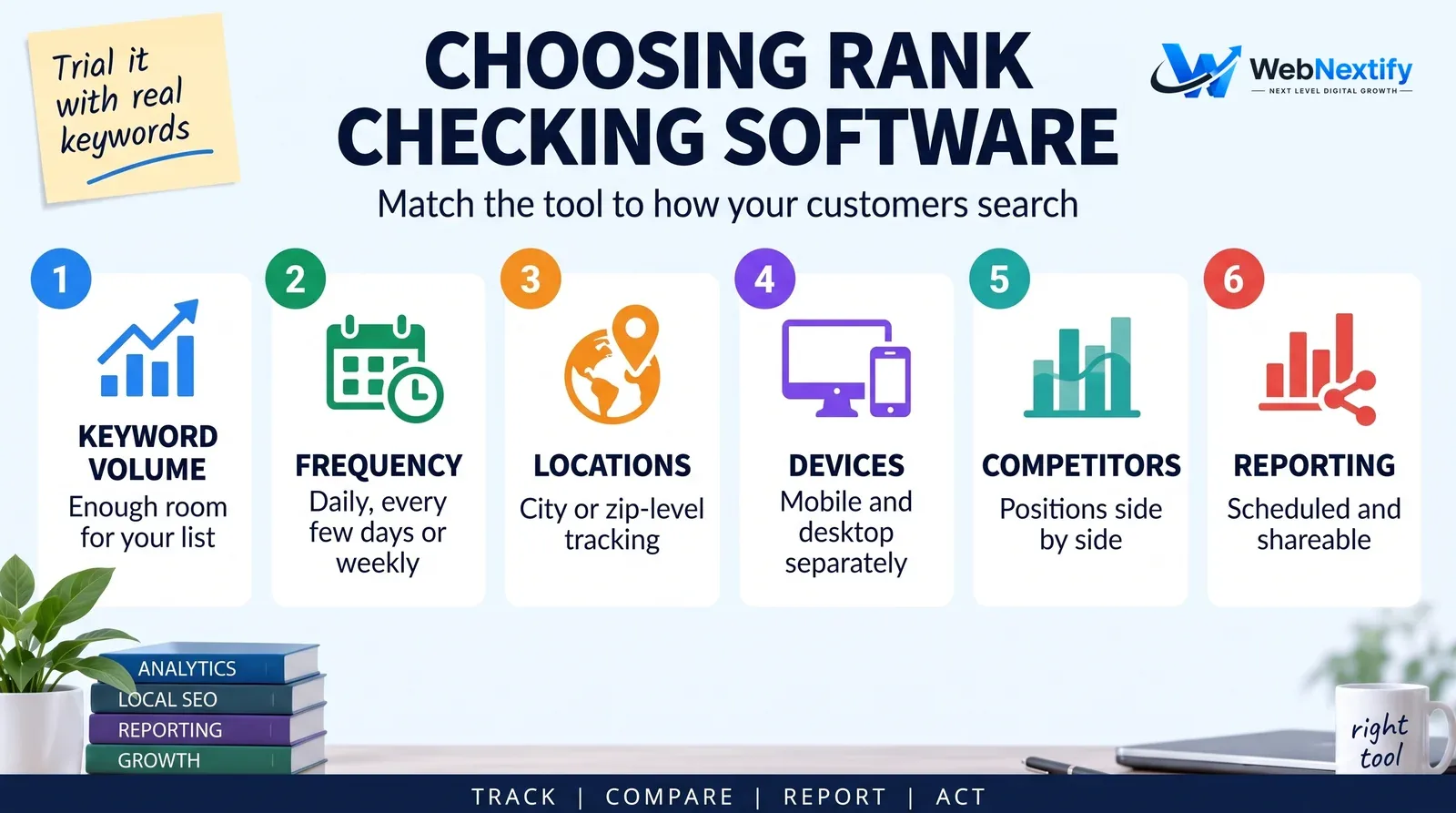
Trial it with your real keyword list, not the vendor's demo data. Then check a few results by hand from the right location and see whether the tool's numbers are believable.
Build a Keyword List Worth Tracking
The list matters more than the tool. Start in Search Console: take the queries already bringing impressions to your money pages, then add the searches you want to win and don't appear for yet. Group them by page or service so each group answers one question, like "how is the plumbing repair page doing?". Keep branded searches in their own group. They almost always rank well and will hide what's happening everywhere else.
Fifty to a few hundred well-chosen keywords is plenty for most small and mid-sized sites. Tracking 4,000 loosely related terms mostly produces noise and a bigger invoice. Prune the list each quarter, dropping terms nobody searches and adding new services.
Expect daily wobble. Rankings shift constantly, partly because Google is always testing, so a one- or two-place move on a single keyword means very little. Watch each group's trend over several weeks, and check big swings against clicks in Search Console before reacting.
If AI answers matter to you, see whether the tool records AI Overviews and which sites they cite for your keywords. Some trackers now report AI assistant visibility separately. Treat those numbers as samples, because AI answers change between runs.
Google My Business Rank Checker: Tracking Local Rankings
Map results depend on where the searcher is standing, so one local ranking tells you almost nothing. A Google Business Profile rank checker, still often called a "Google My Business rank checker", shows your position across a grid of points over your service area. You see where you're visible and exactly where a competitor takes over, often a few miles from your door. If local customers drive the business, make sure the tool does grid or zip-level tracking. Our local SEO services use this kind of data to decide where to focus.
Is There a Google Rank API?
Not the kind most people mean. Google doesn't offer a public API that returns ranking positions for any keyword. It does offer the Search Console API, which returns clicks, impressions, click-through rate and average position for your own verified site, broken down by query, page, country and device.
Be careful with tools or scripts that scrape Google directly. Google's spam policies describe "sending automated queries to Google", including scraping results for rank-checking, as machine-generated traffic that violates its policies. Commercial rank trackers and SEO rank API providers handle data collection themselves, so read their terms and understand where their numbers come from.
When an SEO Rank API or Audit API Makes Sense
An SEO rank API hands you ranking data as raw data instead of a dashboard, and an SEO audit API does the same for crawl and on-page checks. They earn their cost when you're building your own dashboards or joining SEO data to CRM and sales figures, when you're tracking thousands of keywords across many client sites, or when you want audits to run automatically before every release. Keeping years of history in your own database is another good reason.
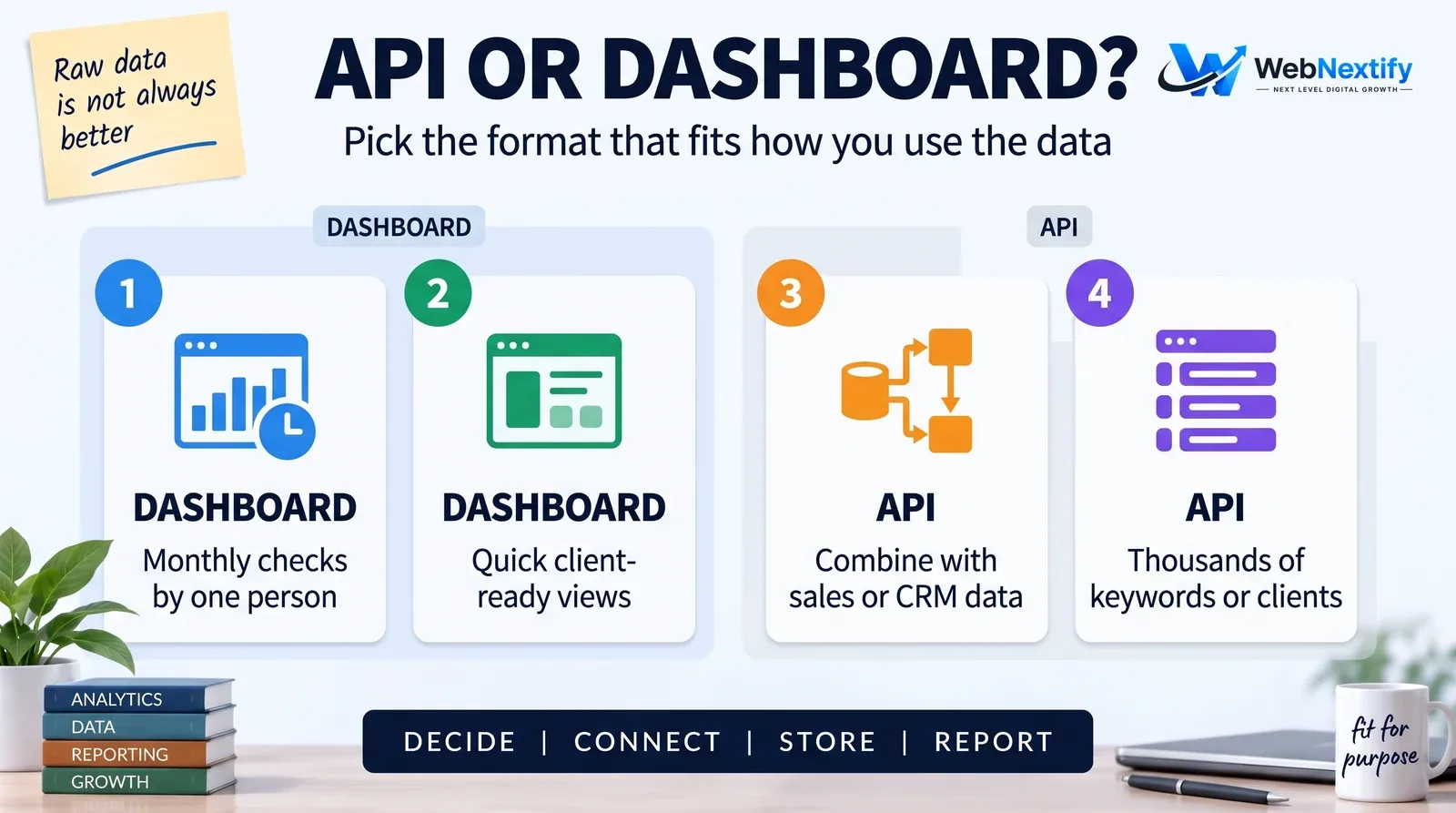
Skip them if you'd be the only person reading the data, once a month. A dashboard is cheaper and faster for that.
How to See What Keywords a Website Is Using
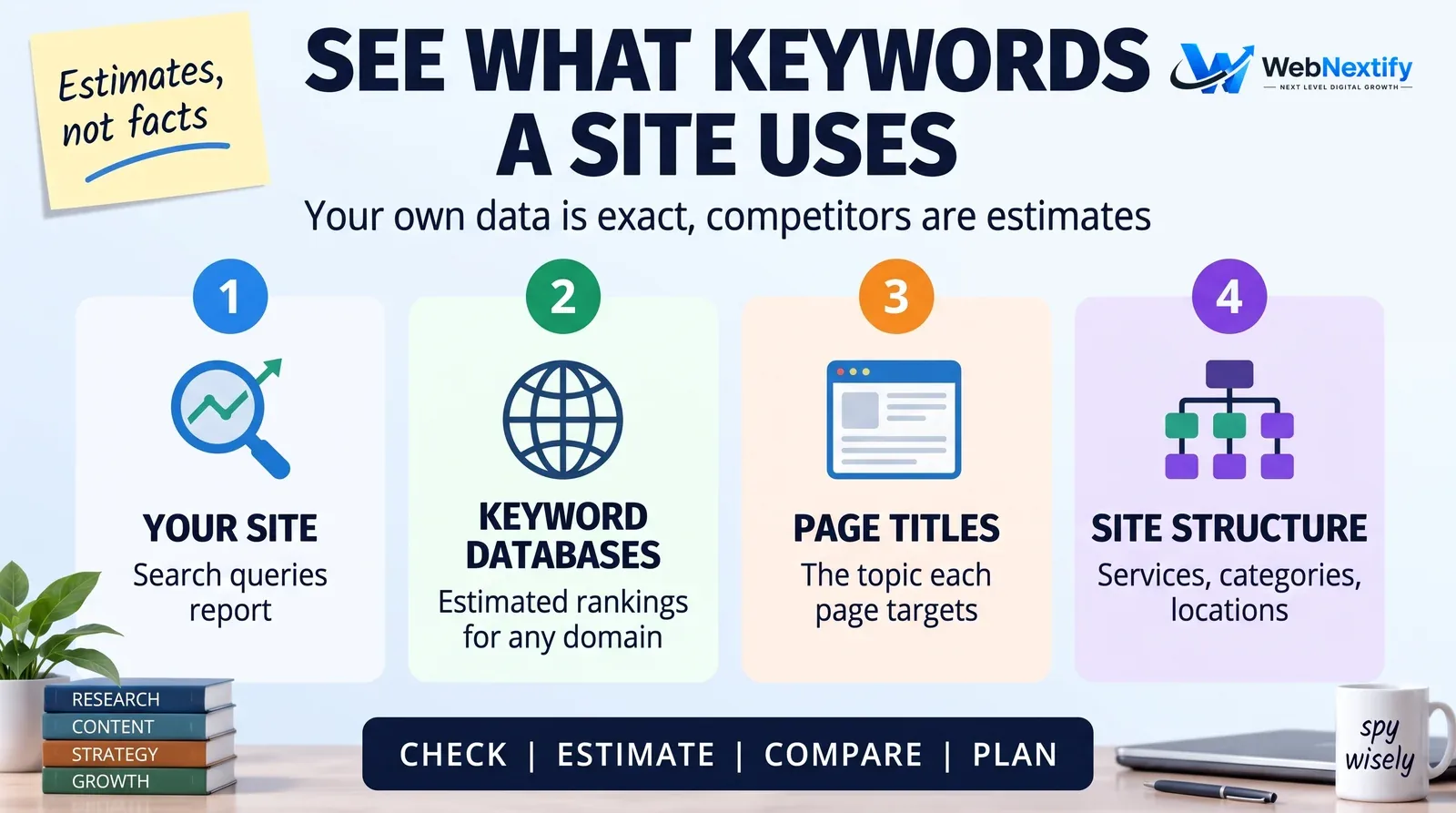
For your own site, Search Console's Performance report lists the queries your pages appear for, and nothing is more accurate.
For a competitor, you can't see their Search Console, so you're working with estimates. SEO suites with keyword databases estimate which keywords a domain or page ranks for and roughly how much traffic it gets; different tools will disagree, so treat the numbers loosely. Their pages tell you a lot too. Page titles usually show each page's target. Their location pages show which towns they're chasing.
Checking a single page is simpler. To see whether a word appears on it, press Ctrl+F (Cmd+F on a Mac) and type it. For the meta description, which you can't see on screen, right-click, choose View page source and search the source the same way. Browser extensions and SEO tools show headings and meta tags in one panel, which is quicker when you're checking twenty pages.
Get Help With Rank Tracking
If you'd like a rank tracking setup built around the searches your real customers make, with local tracking where it matters and reports that connect positions to clicks and leads, see our SEO services.
Frequently Asked Questions
What is the best SEO rank checking software?
How many keywords should I track?
Is there a free rank checker?
Does Google have a rank API?
Is it against Google's rules to scrape rankings?
How can I see what keywords a competitor ranks for?
How do I track local rankings for my Business Profile?
Summary
Pick rank checking software by what you actually need to track, and run it alongside Search Console, never instead of it. Reach for an API only when you're combining data or working at scale. And treat every number about a competitor's keywords as an estimate.