A white label SEO audit carries your agency's name even though someone else's software or team produced it. There are two ways to do it. You can use a white-label audit tool that crawls the site and spits out a report with your logo, colors and domain, or you can hire a fulfillment partner who does the audit and hands you a finished report to send as your own. Plenty of agencies use both: a tool for quick checks and lead generation, a partner for the deep audits.
Whichever route you take, your name is on the cover. A wrong finding, a generic recommendation or a missed problem lands on you, not on the vendor. That's why quality control matters more than any feature list here.
Option 1: White-Label SEO Audit Tools
A white label website audit tool is software you dress in your branding. Agencies use them for branded PDF reports for prospects and clients, for an audit form on their own website where a visitor enters a URL and gets a report (usually in exchange for an email address), for scheduled re-audits of existing clients, and for client dashboards on their own subdomain.
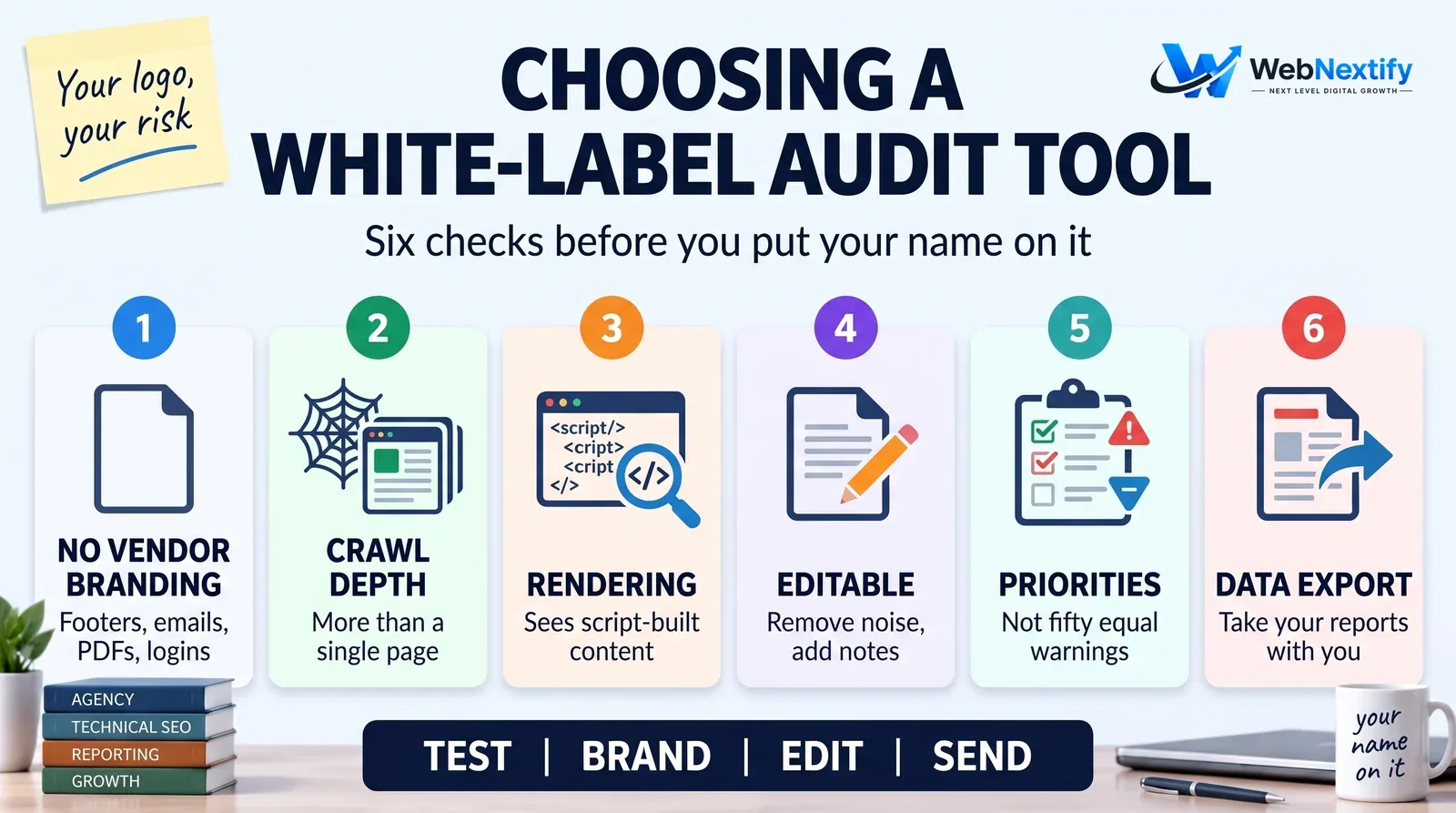
What to check before you sign up:
| Check | Why it matters |
|---|---|
| Vendor branding removed everywhere | Report footers, emails, PDF properties and login pages can all show the vendor's name |
| Crawl depth | Many tools only check one page, or cap the number of pages |
| JavaScript rendering | Without it, the tool may miss content on modern sites |
| Editable reports | You need to remove irrelevant warnings and add your own notes |
| Issue prioritization | Long lists of equally weighted warnings undermine your advice |
| Custom domain | Reports and forms should run on your domain |
| Data ownership | Can you export reports and leads if you switch tools? |
Free white-label SEO audit tools
Free plans exist, and they come with strings: one-page checks, a vendor badge on the report, a handful of audits a month, no custom domain. They're fine for testing whether prospects will actually use an audit form on your site. For client work, the limits bite quickly.
Audit forms for lead generation
An audit form can bring in leads, but the automated report is often the first thing a prospect ever sees from your agency. Edit the template so it highlights a few real issues instead of a score and fifty generic warnings, and follow up personally. A report screaming "84 critical errors" over missing alt text on decorative images does more damage to trust than no report at all.
Option 2: White-Label Audit Partners
A fulfillment partner does the audit and you deliver it as your agency's work. It makes sense when you sell audits but don't have the specialist hours in-house, or when demand arrives in waves.
Agree the terms before the first project. Scope comes first: what the audit covers, technical, content, links, and what it doesn't. Then format: your template, your branding, your severity scale. Settle turnaround and revision rounds, and who answers the client's questions (you, with the partner supporting). Get an NDA plus a non-solicitation clause so the partner can't approach your client, and agree there's no direct contact between them at all.
Data access deserves its own rule. Give the partner read access to Search Console and GA4 through your agency's accounts, never the client's owner login, at the lowest permission level that lets them work, and remove it when the project closes. Your client trusted you with their data, not a company they've never heard of.
Walk away from partners who guarantee rankings, who mention private blog networks or bulk link packages as part of an "audit", or who won't show you a real sample. A three-day turnaround on a 20,000-page site is a warning sign too. It usually means a tool export with your logo pasted on.
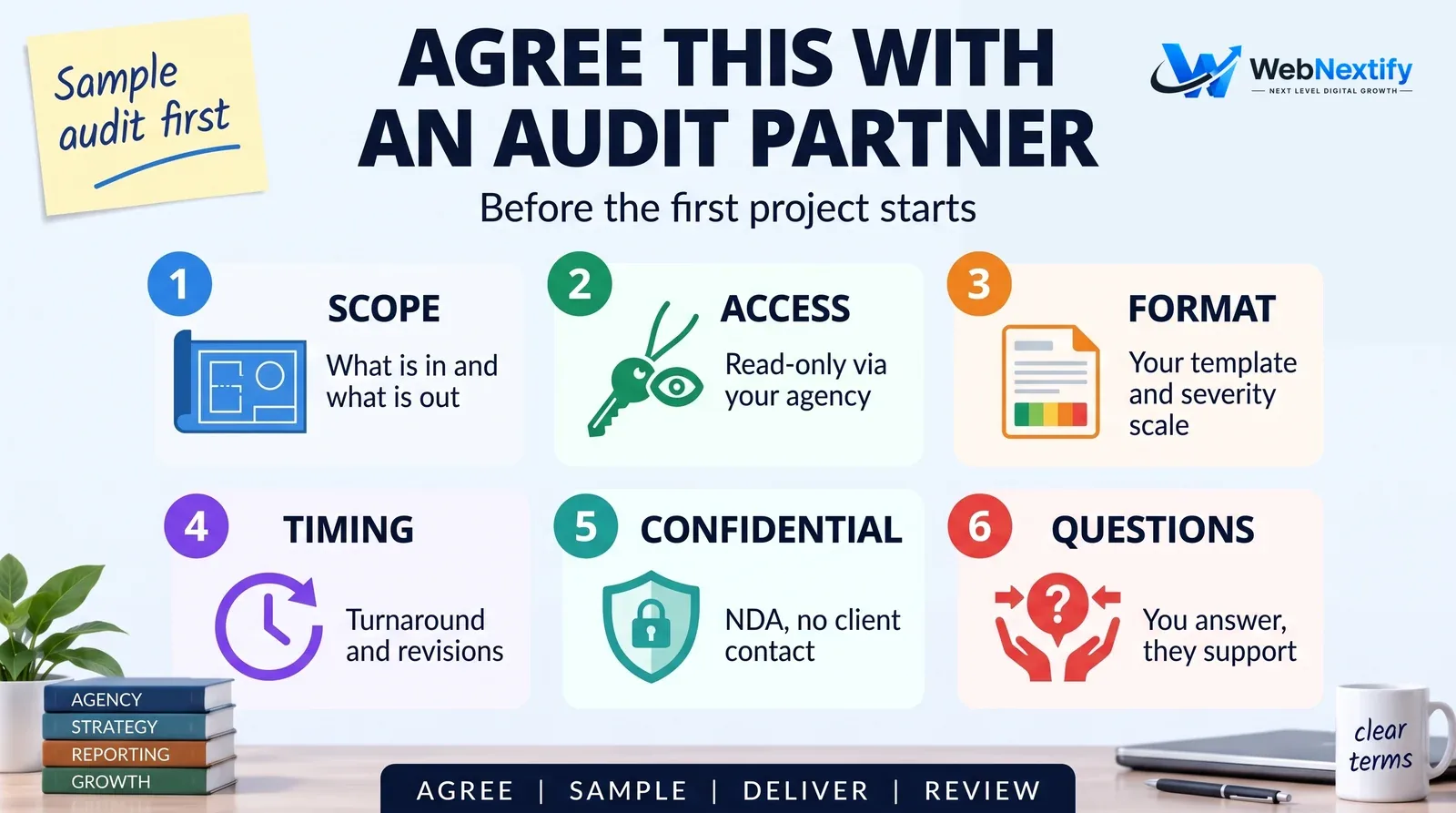
Ask for a sample audit with the client's details removed before you commit, and read it the way your client would. Are the findings specific to that site? Is each one explained? Is it obvious what to fix first?
Quality Control Before Anything Goes Out
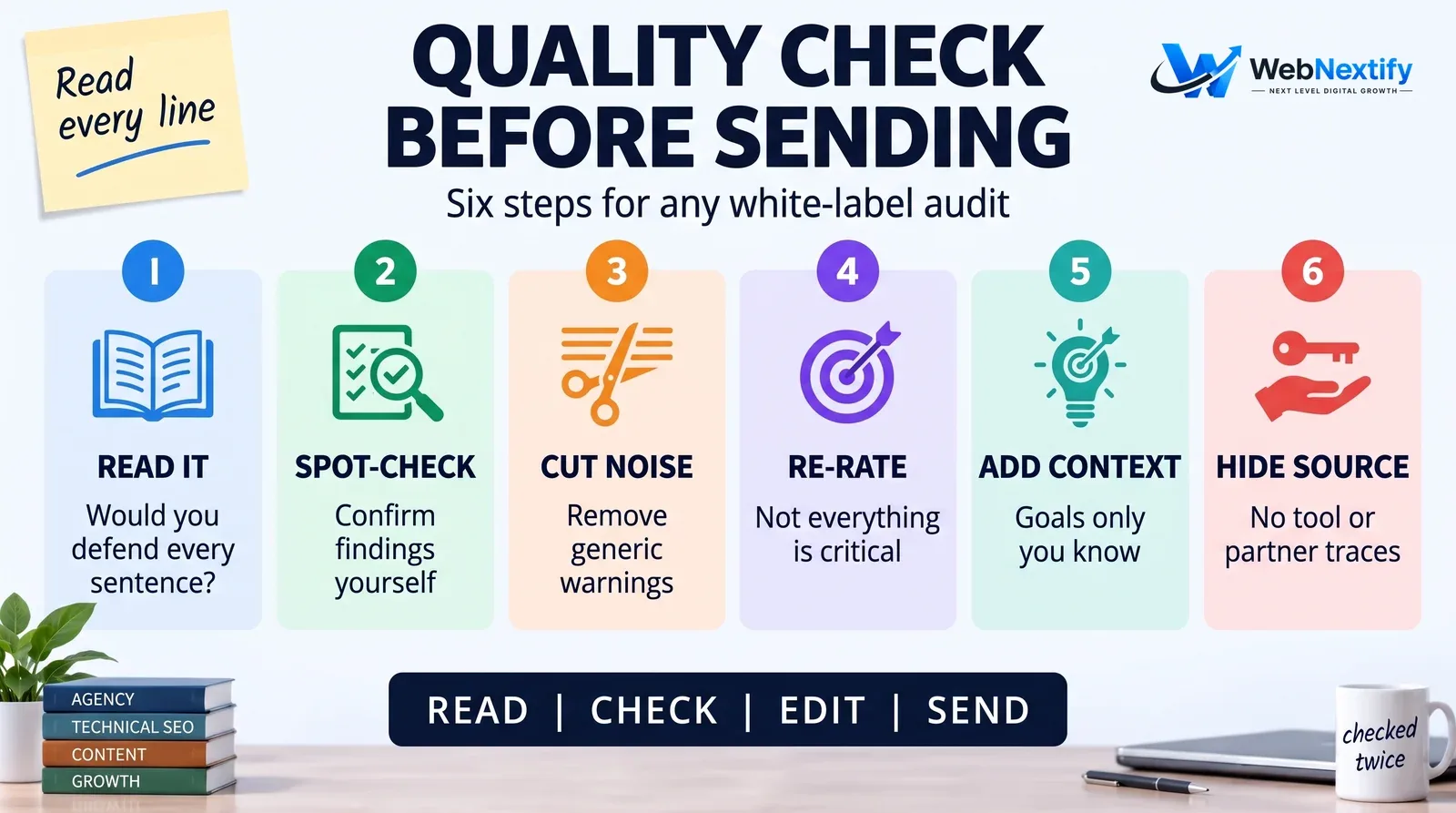
Whoever produced the audit, read it before it leaves your hands. Start with the summary: would you defend every sentence in it across a meeting table? Spot-check a few findings in Search Console and on the live site, because tools produce false positives. Strip out generic warnings that don't apply to this site, and re-rate severity if everything has been marked critical.
Then add what only you know: the client's goals, the work you've already done for them, the constraints their developer is working under. And if the arrangement is white label, check that nothing in the file names, footers or PDF properties gives away the tool or the partner.
Our SEO audit services guide covers what a strong audit should include, so you can hold any partner to the same standard.
Being Honest With Clients
White labeling is normal and common. It shouldn't involve misleading anyone. Don't claim credentials or experience you don't have, make sure your contracts allow subcontracting, and stand behind the work you deliver. What you're selling is a clear audit and a plan, and that's true no matter who ran the crawler.
Pricing a White-Label Audit
Your price has to cover the tool or partner cost, your review time, the client walkthrough and the questions that follow. Agencies that charge the partner's fee plus a markup often lose money on the review and the calls. The walkthrough is where most of the value lands for the client, so build it into the price rather than giving it away.
Get a Partner for Audits
If you're an agency looking for audits you can deliver under your own brand, with findings written for your clients rather than exported from a tool, talk to us about our SEO services. For a quick technical check of a single page, the free WebNextify SEO Report Generator works without a login.
Frequently Asked Questions
What is a white label SEO audit?
What should a white label SEO audit tool include?
Are free white label SEO audit tools any good?
How do I choose a white-label audit partner?
Do I need to review a white-label audit before sending it?
Is white labeling SEO audits ethical?
Summary
White-label audits let an agency offer more without hiring, but the agency carries the risk. Pick tools that hide the vendor and let you edit the report. Pick partners whose sample audits are specific and prioritized. Then read everything yourself before a client sees it.