An AI business analyst, in practice, is a business analyst who lets AI tools do the slow parts of the job. Workshop notes become draft requirements in minutes. A written procedure becomes a process map outline, a messy spreadsheet gets a first round of checks, and a report gets its first draft. The judgment stays human: which problem actually matters, what's going on politically in the room, and whether a requirement reflects what the business needs or just what someone said.
Used that way, AI buys back time for the work analysts are hired for. Used carelessly, it produces confident documents built on misunderstandings, and those are worse than no documents at all.
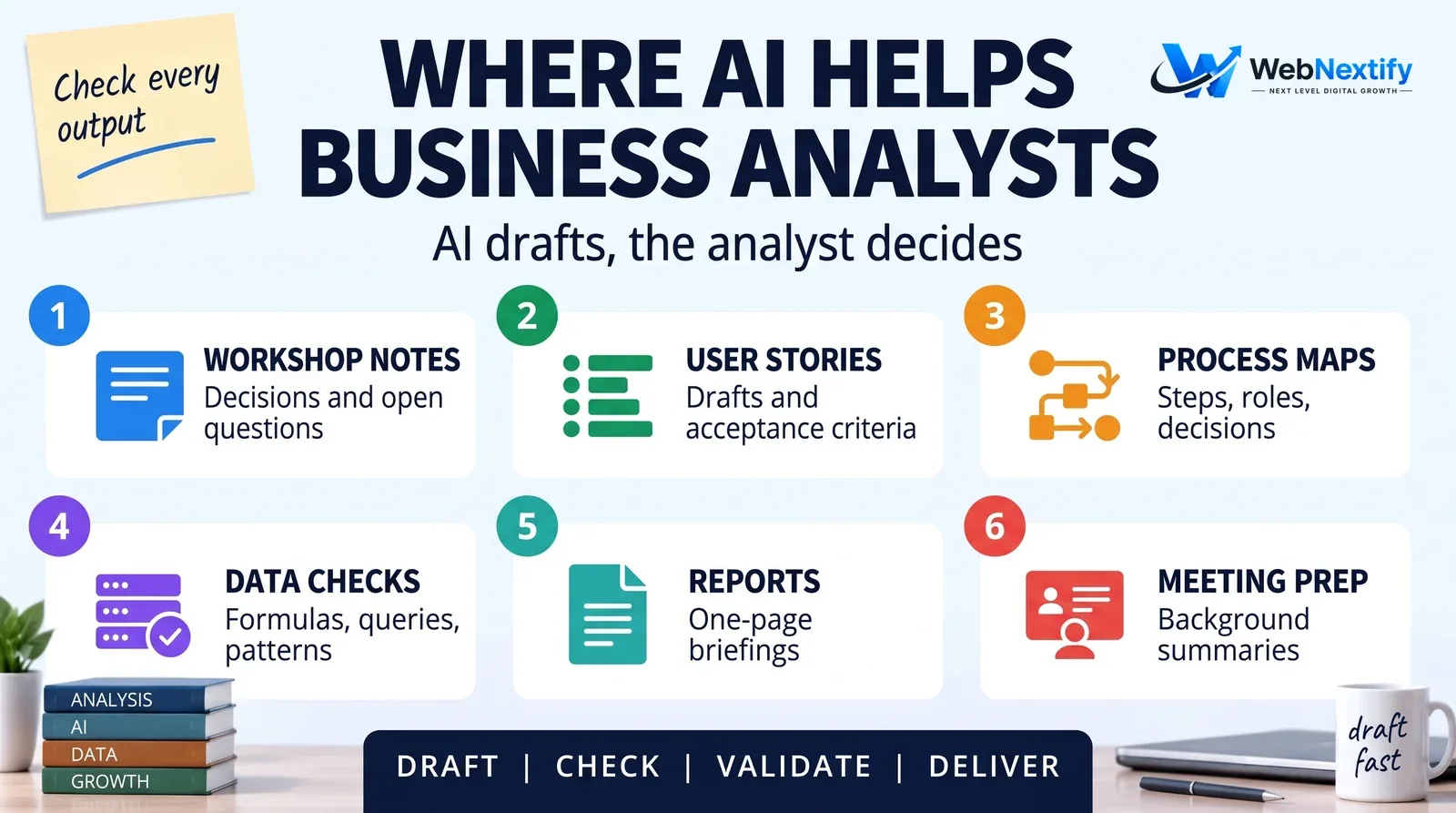
Where AI Helps Business Analysts Most
| Task | How AI helps | What still needs you |
|---|---|---|
| Elicitation notes | Summarize interviews and workshops, pull out decisions and open questions | Asking the right questions, noticing what wasn't said |
| Requirements and user stories | Draft stories and acceptance criteria from notes | Checking they reflect the real need |
| Process mapping | Turn a written process into steps, roles and decision points for a diagram | Validating with the people who do the work |
| Data analysis | Explain datasets, suggest checks, write formulas and queries | Verifying results against the source |
| Documentation | First drafts of specs, reports and briefings | Accuracy, tone and stakeholder fit |
| Meeting prep | Summarize background documents and list likely questions | Reading the room |
Practical AI Workflows for Business Analysts
Start with workshops. Record one (with everyone's permission), transcribe it, and ask an AI assistant to list the decisions, open questions, risks and stated requirements, citing the part of the transcript each one came from. Correct what it got wrong, then send it to the participants to confirm. What used to eat an afternoon takes under an hour, and the citations make checking fast.
Process mapping works the same way. Describe the process in plain text, or paste an existing procedure, and ask for a step-by-step list with roles, inputs, outputs and decision points. Build the diagram from that, then walk through it with the people who actually do the work. They'll always find steps nobody wrote down. Our guide to AI workflow automation goes deeper on mapping a process before you automate it.
With data, AI assistants are good at explaining what a dataset contains, suggesting quality checks, writing spreadsheet formulas or SQL, and describing patterns. Verify every number in the original tool anyway. AI can miscalculate or invent figures when it summarizes, especially from large or messy files, and it won't tell you when it has.
Reports are the easiest win. Give the AI your findings and describe the audience, then ask for a one-page briefing in plain language. Edit it until it sounds like you, and check each figure against your analysis.
AI Tools for Business Analysts
Most analysts end up with a general AI assistant for summarizing, drafting and explaining, plus the AI features now built into tools they already use: office suites, diagramming tools, ticketing systems and BI platforms. Meeting transcription tools save a surprising amount of time. BI tools with natural-language querying let you ask a question about the data in plain English instead of building a report first.
Before any of them touch company data, check your organization's rules on which tools are approved and what data can go into them. Our guide to AI governance covers how to set those rules if nobody has yet.
Skills and AI Business Analyst Jobs
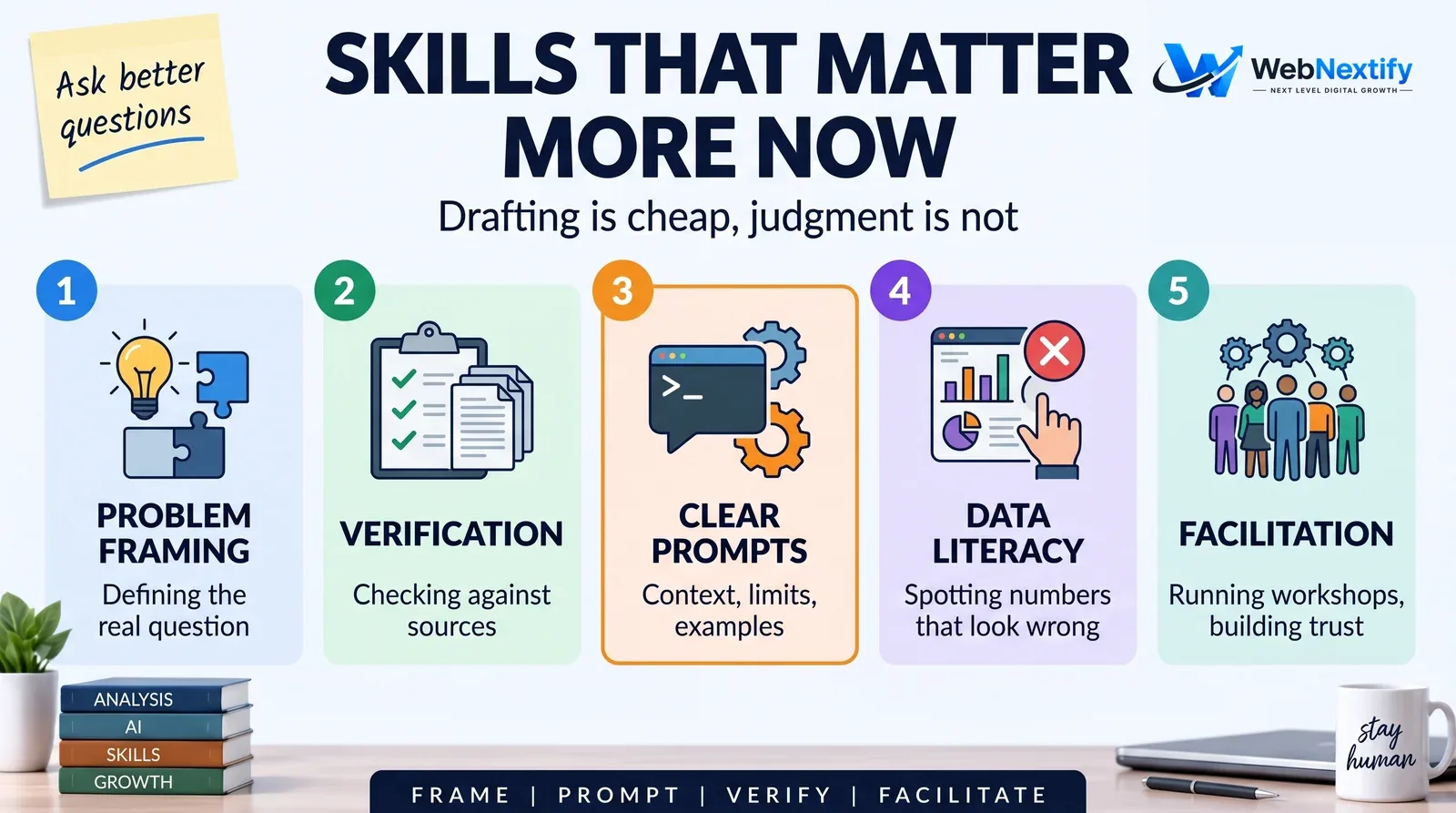
AI moves where a business analyst adds value. When drafting is cheap, framing the problem correctly matters more, because a fast answer to the wrong question is still wrong. Verification is now part of the job description; someone has to check AI output against the source, and that someone is you. Prompting well is mostly about context. Clear inputs, constraints and an example or two produce far better drafts than a one-line request. Data literacy matters too, in the plain sense of noticing when a number looks off.
None of that replaces facilitation. AI can't run a workshop, and it can't earn the trust of a stakeholder who thinks the last project failed because of people like you.
Employers are asking for the same mix. Job listings increasingly want analysts who can show responsible use of AI tools, and some roles now focus on spotting AI and automation opportunities in existing processes. The core of the role hasn't gone anywhere. Someone still has to understand the business and make sure the solution solves the right problem, and analysts who pair domain knowledge with AI fluency are well placed.
The wider numbers are steady. The US Bureau of Labor Statistics groups many business analyst roles under management analysts, and its Occupational Outlook Handbook projects employment growth of 10 percent from 2025 to 2035, much faster than the average for all occupations, with about 94,100 openings a year. It lists a 2025 median pay of $101,860. Those figures cover the whole occupation rather than AI-specific roles, but they don't describe a profession being replaced.
Small Business Intelligence With AI
Small businesses rarely have a dedicated analyst, and AI puts basic business intelligence within reach anyway. An owner can export sales, bookings or website data to a spreadsheet and ask an AI assistant which products sell best by month, which channels bring customers who come back, or what changed last quarter. The same rule applies as in any analyst's work: check the numbers against the source before you make a decision on them.
Get Help Bringing AI Into Analysis Work
If you'd like help setting up AI tools around your processes, reports or data, with the right controls in place, see our AI chatbot and automation services and our guide to AI business solutions.
Frequently Asked Questions
What is an AI business analyst?
How can business analysts use AI?
What are the best AI tools for business analysts?
Will AI replace business analysts?
Is business analysis still a good career with AI?
What skills do AI business analyst jobs require?
Can a small business use AI for business intelligence?
Summary
Let AI write the first drafts. Spend the hours you save framing the right problems and working with people. That combination is what an AI business analyst really is.